
Stygia
A southern kingdom of the Hyborian Age bounded by the Western Ocean on the west, the River Styx on the north and east, the kingdoms of Kush, Darfar and Keshan on the South.
Name:
Stygia
Aliases:
Start year:
1970
First issue:

"Human foes he did not fear, nor any death by steel or fire. But this was a black land of sorcery and nameless horror. Set the Old Serpent, men said, banished long ago from the Hyborian races, yet lurked in the shadows of the cryptic temples, and awful and mysterious were the deeds done in the nighted shrines."
Robert E. Howard: "The Hour of the Dragon"
Overview:
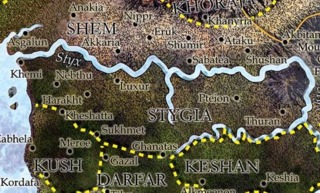
A southern kingdom bounded by the Western Ocean on the west, the River Styx on the north and east, the kingdoms of Kush, Darfar, and Keshan on the South. The Stygians were a mysterious people, the ruling elite tall, dusky, hawk-nosed, and haughty while the lower classes were a mixture of Negroid, Stygian, Shemite, and Hyborian stock. Stygia was a theocracy controlled by the priests of Set, the Serpent-God. The administrative capital and seat of the king was Luxur, lying inland and south of the Styx on an important caravan route. The greatest port and religious center was at Khemi. Sukhmet and Kheshatta were apparently caravan cities that serviced traders from the black nations. From the coast, it was possible to take a caravan trail all the way to Sukhmet and presumably beyond.
After the Cataclysm, the land of Stygia was invaded by a large body of Lemurian survivors, originally from the Far East. They destroyed a pre-human race of serpent-folk to establish what was probably the first of the post-Cataclysmic kingdoms of the West -- Old Stygia. A remnant of the serpent-race survived in the Far South and in a few other places. The serpent-worship characterizing the religion of the nation had its basis in the veneration of the vanished snake-beings.
During Conan's time the nation represented a menace of ancient sorcery.
Note - In many ways Stygia is analogous to ancient Egypt as well as proto-Egyptian speculation from late 19th century occult thought.


