
The Order of St. George
A secret society of monster hunters, scattered across the world, dedicated to not only protecting the world from monsters but keeping their existence a secret.
Name:
The Order of St. George
Publisher:
Aliases:

Origin
The Order of St George takes their name from the Golden Legend of St. George. According to legend, a town was forced to feed its children to a dragon to stop it from attacking them. St. George captured the beast and made the town swear an oath to God. Once they did, he killed the beast and built a church on that very spot. In reality, the church was the original headquarters of The Order of St. George, and the oath was to keep the existence of monsters a secret. Unfortunately, St. George never saw the Order come to be. He was martyred long before they assembled with his death serving as an inciting event.
Creation
The first appearance of a single member of The Order of St. George was in Something is Killing the Children #1 by James Tynion IV and Werther Dell'Edera. More members, specifically from the House of Slaughter chapter house, would eventually debut in issue #5
Structure
Hierarchy
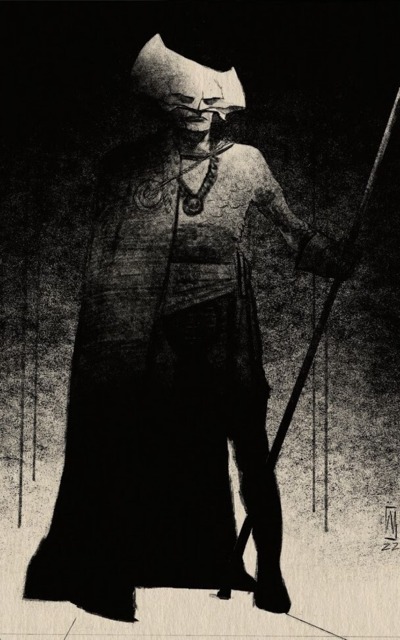
- The Dragon King: The spiritual leader of The Order of St. George and the keeper of St. George's history. His will is law within The Order, and his decisions decide the direction of their deepest traditions. He is selected by The Congregation of Houses upon the death of the previous Dragon King.
- Violet Masks: Emissaries of the Dragon King, the head of the Order. They oversee the transition of Dragons (heads of houses), resolve territorial disputes between houses, and revoke house charters.
- Chapter House Dragons: Traditionally, they were former Emerald Masks, however, the rules have loosened in the modern era. After the death of a house's leader, the Violet Masks approve a new leader and bestow a Gold Mask.
- The Council: The Chapter House Council is made up of the superior members of each mask within the House to ensure no internal conflicts among branches.
- The Hunters: Each House is assigned a geographic location by The Great House for which they are responsible for hunting monsters and keeping the secret of their existence.
- The Council: The Chapter House Council is made up of the superior members of each mask within the House to ensure no internal conflicts among branches.
Division of Responsibilities
- Azure Masks: The Blacksmiths, they build all the monster hunting weapons and moderate the tests of skill. They are also placed within positions of power including politics and the media to help keep the secret.
- Black Masks: One of four types of hunters, they are hunters that work alone in the field.
- Emerald Masks: One of four types of hunters, they are considered the most dangerous. They hunt literal dragons.
- Scarlet Masks: The Bookkeepers, who track the lives of hunters. However, they often double as servants, caring for the chapter houses.
- Silver Masks: One of four types of hunters, they are specialists. They hunt monsters with established rules, like vampires or werewolves, and are more prevalent at chapter houses in countries with more culturally ingrained folklore.
- White Masks: One of four types of hunters, they are pack hunters. They are trained to take on big game as a team.
Initiation
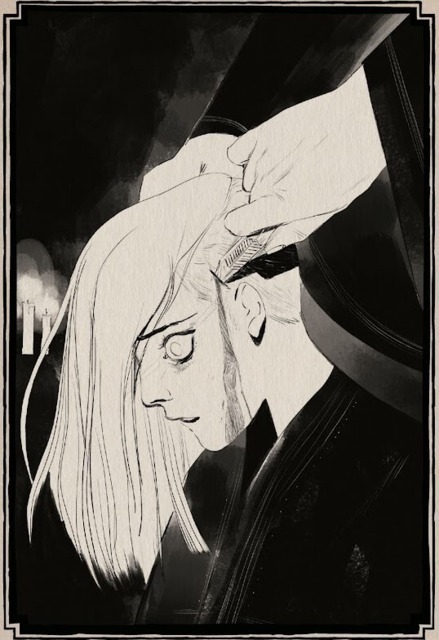
In the old days, young people who survived an attack would be tested against the monster that traumatized them. They would face off in a shared dreamscape, where they get a chance to tame the monster and lock it in their totem: an item, usually a toy, of great meaning to the hunter. Due to the survival rate being relatively low, the Order largely changed the initiation test, except for certain circumstances, like Erica Slaughter. They would profile orphans and test them against random monsters, as opposed to the monster that attacked them.
If they pass the test, they receive the Mark of St. George, a tattoo of a dragon with spears through it. They also receive a solid color bandana to wear in their chapter house. They are trained in the ways to kill monsters. Once they get their first kill, they receive a new bandana with teeth on it, making them a full-fledged monster hunter.
Before they leave their teenage years, the initiates must pass one more test so that they can perform the Rite of Trepanation, which will allow the monster hunter to continue seeing monsters into adulthood, since only children could see them. During the ritual, a gold nail is inserted into one of their temples. On rare occasions, a monster might gain enough power to be visible to adults. The principal goal of the Order is stopping that from occurring.
The Totem
The totems were childhood belongings in order to make a personal connection to the hunter as a lone sentimentality. This would allow the totems to devour all other sentimentalities that arose, since the initiation is secretly a ritual to bind the hunter and totem rather than a test of mettle. This feeding allowed fear and anger to grow in the hunters, making them ever ready to fight off monster threats.
Problems arose when a new monster type emerged. It was an ever evolving oscuratype that could teach totems to feed outside of the binding ritual. It led to the destruction of the House of Blood and nearly destroyed the House of Slaughter. Members of the House of Slaughter who were responsible for revealing the monster's influence were given promotions . Edwin Slaughter and Bait were made Silver Masks, specializing in this new monster type, while Nolan Slaughter was made a rotating Azure Mask, responsible for investigating hidden dangers within each of the houses.
The Tournament of Teeth
The Tournament of Teeth occurs every five years. It is a series of games and challenges taken on by the best of each House across all masks. They are held at a different House each year. Winners receive gold, opportunities, and notoriety. It was originally conceived as a way to unite the Houses, some of which were so spread out across the globe that they may never cross paths with each other. It also served as a way for the Dragons to meet and share wisdom.
Expansion
The Eurasian Expansion

After a hundred years defending the Mediterranean, the Order saw a need to spread across the world in every direction. They called it The Great Expansion.
Two of the hunters sent on this mission were twin brothers, Marcus and Titus, descended from one of the original hunters and trained in every mask color. They went west into Europe, freeing cities from threats of monsters as they journeyed, eventually, splitting up. Titus would found the House of Carnage in Paris, France, and Marcus would found the House of Cutter in London, England, the house that would be responsible for the widest expansion in The Order's history.
However, the hunters going east had different challenges. Asia already had their own resident monster hunting orders. It was the policy of The Order to first offer peace, believing they could benefit from their regional wisdom and experience. If assimilation failed, the only other option was elimination. The Order believed that a united front was necessary for ensuring the security of the world. The order managed to assimilate the orders of Japan and India, but the orders of Korea and China required elimination.
The American Expansion

The Second Great Expansion was marked by the discovery of the New World. European countries were vying for territories of the Americas, and the Houses were stowing away to investigate the New World for its potential for new Houses. In 1666, Scarlet Mask Samuel Cutter would make landfall in the colony of New York with a Black Mask, Brutus Cutter. Once there, they were attacked by a similar duo from the House of Carnage. One of them managed to cut Brutus' arm off. Before he bled out, he managed to kill the two Carnage hunters. Samuel would take up his partner's black mask and start the New York chapter, The House of Blood.
Samuel grew tired of House of Cutter's influence over the House of Blood and abandoned his first American House. He created a new house in Chicago, naming it House of Slaughter. This he would comprise of all Americans, angering the House of Cutter. They continued to funnel resources to the House of Blood, however, World War I would require the House of Cutter to cut its funding and focus on defending their homeland. This left the House of Blood unable to keep its prestige and eventually fell when it was mysteriously attacked by monsters.
Meanwhile, in the South, the House of Carnage opened their own chapter house, The House of Boucher. With the House of Blood gone, Slaughter and Carnage entered a new territory agreement. Since Slaughter has assimilated surviving hunters from Blood, Slaughter's territory grew exponentially, covering from California to New England. In exchange, Boucher would get exclusive rights to trading monster by-products to the rest of the Order.
The House of Slaughter Expansion
With the Old Dragon of the House of Slaughter on his deathbed, Cecilia Slaughter took a meeting with purple mask, Victor Saint-Georges, emissary of the Dragon King. Cecilia made her intentions known that she wants to take his place and requested the support of the Great House. She explained that the influence of the American houses is not equal to the influence of the country, even though it should. She explained that they were the dominant of the American houses due to the amount of people they had placed in the government and media and the scientific innovations spearheaded by the late blue mask, Big Gary.
Cecilia's plan was a large expansion. She wanted domestic satellite houses in San Francisco, near the tech giants, and in DC, at the center of the government. She also wanted satellites in Seoul and Dubai. Unlike other house expansions, these houses would be Slaughters rather than their own identity. She even got a commitment from the House of Boucher that they would cooperate in exchange for their own satellites in Mexico City and Sao Paulo.
Congregation of Houses
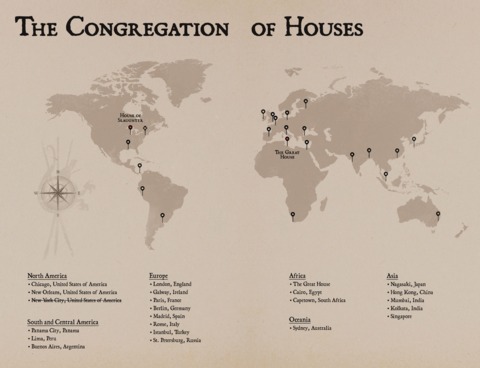
North America
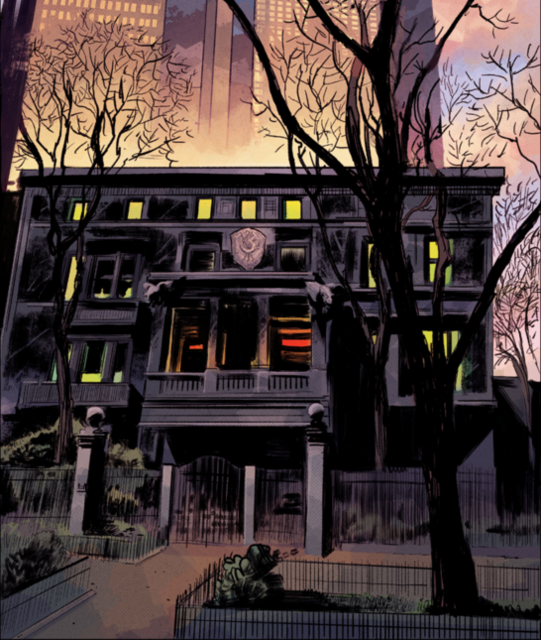
- Chicago, USA - House of Slaughter
- New Orleans, USA - La Maison du Boucher
- New York City, USA, currently defunct - The House of Blood
South and Central America
- Panama City, Panama
- Lima, Peru
- Buenos Aires, Argentina
Europe
- London, England - House of Cutter
- Galway, Ireland
- Paris, France - La Maison de Carnage
- Madrid, Spain
- Rome, Italy
- Istanbul, Turkey
- St. Petersburg, Russia
Africa
- The Great House, original chapter house and home of the Dragon King
- Cairo, Egypt
- Capetown, South Africa
Oceania
- Sydney, Australia
Asia
- Nagasaki, Japan
- Hong Kong, China
- Mumbai, India
- Kolkata, India
- Singapore
Notable Members
Samuel Cutter: Samuel Cutter was a member of House of Cutter, who was sent to America in the year 1666 to investigate the potential for new houses, eventually starting both the House of Blood in New York and the House of Slaughter in Chicago.
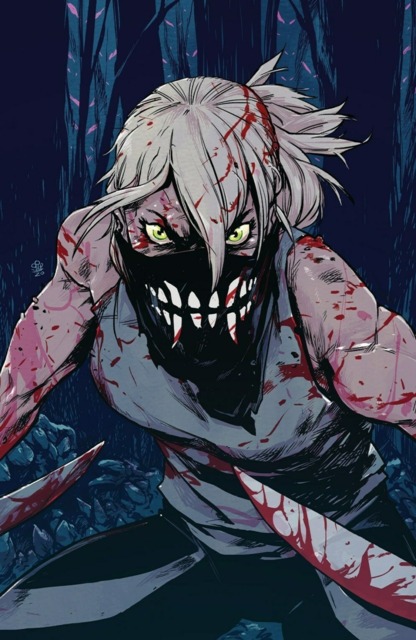
Erica Slaughter: Erica Slaughter was the most recent Black Mask for the House of Slaughter. She had a rebellious spirit and often butted heads with the administration of her House. After her hunt in Archer's Peak went bad, she quit the Order and continued to hunt freelance.
Jace Boucher: Jace grew up in the New Orleans branch, La Maison du Boucher. Jace's parents died in an attack on their chapter house orchestrated by The Old Dragon of Chicago. Later, Jace conned his way into the House of Slaughter so he could get his revenge. It failed, and Jace was marked a traitor. Aaron Slaughter was sent to kill him, but Aaron had romantic feelings for Jace, so he was spared.
Charlotte Cutter: Cutter was a black mask from the House of Cutter in London. She was brought to America by the House of Slaughter to hunt down Erica after she quit and dropped off the grid. However, the House of Slaughter was not prepared for the violent lengths Cutter would go to track and take Erica out.
Edwin Slaughter: Edwin is a red mask from the House of Slaughter. He made a deal with a monster when he was a boy to get him membership with the Order if the monster could have the safety of being his totem. While on assignment, Edwin has an encounter with a dragon, a monster species believed to be extinct. He would later be made a Silver Mask and be partnered with Bait.
Maxine Slaughter: Maxine was one of the White Masks in the House of Slaughter. She had a low opinion of Erica Slaughter and a high opinion of Aaron Slaughter. As one of the more prominent White Masks, she was offered the role of Black Mask after Erica left. Since Erica was the only black mask at the House of Slaughter, Maxine was sent to other houses to be trained.
Gerde Slaughter: Gerde was a red mask from the House of Slaughter. She worked under Colin Slaughter, who was the red mask on the house council. She was slowly manipulating her way on to the council so that she could become the Dragon of Slaughterhouse. She was secretly an actual dragon, the same dragon who destroyed the House of Blood many years ago.
Monstrum
Monstrum are manifested by the imagination of humans. Like fear, they are influenced by cultural difference and environmental factors
Taxonomy
- Type: Generic classification
- Class: Specific classification, all but Oscuratypes have one
- Letter: Estimated point in life cycle, given A - F grade, A being eldest
- Number: Estimated Kill Count
- Example: Duplictype Doppelganger F1 = Doppelganger Newborn with 1 estimated kill
Classifications

Oscuratypes: Most generic and populous monsters. They have no classes
Animatype: Monsters manifested from the fear of real animals
- Multiple classes based on the animal they most resemble (Alligator Animatype, Giant Wasp Animatype, etc)
- They assume all characteristics of their respective animal including how best to kill them
Duplicitype: Monsters manifested from the fear of humans.
- Oculus Class - The most common class, takes the form of a known abuser or infamous criminal
- Doppelganger Class - Manifests from the fear of self, taking their creator's image
- Changeling Class - Manifests from the fear from new parents. They replace a newborn to feed off said parents. An exceptional class that can be seen by adults.
Phantasmatype: Monsters manifested from a loss love or a great tragedy
- Commonly referred to as ghosts or spirits, if they possess another monster they take on that monsters traits
- They can be anchored to totems to be used by hunters for guidance and monstrous knowledge.
Chimeratype: Monsters manifested from paranoia, they borrow traits from both Animatypes and Duplictypes.
- Were-Beast Class: Human-animal hybrid, which could be any animal
- Were-Wolf: The most populous of werebeasts, its popularity in pop culture has standardized silver bullets and blades as a weakness, across all werebeasts
- Deviant Class: Rare Chimeratype that can transform into any human, animal, or potentially monster.
Nosferatype: Monsters manifested from the fear of disease and infection
- Common Vampire Class: The monster most influenced by pop culture, once a bloodthirsty beast, now an attractive seducer. Feeds on blood exclusively
- Succubus/Incubus Class: Feeds on sexual energies and fluids
- Psychic Class: Feeds on human emotions
Necrotype: Monsters manifested from the fear of death
- Common Necrotype: An undead humanoid
- Phantasma-Necrotype: A Phantasmatype possessing a dead organism, classified with necrotypes instead of phantasmatypes due to method of slaying
Mythotype: Monsters manifested by specific folklore

- Far too many classes to name. Mythotypes are hyper-specific to locations, time periods, and cultures
- Chimeratypes and Nosferatypes were once classified as Mythotypes until their lore gained worldwide prominence
Dracotype: Monsters manifested from a civilization's collective horror
- Modern (or Common) Dragon Class: Generic with very little cultural characteristics. One theory is they are an Oscuratype at full maturity.
- Medieval Class: Dragons that resemble those from European cultures
- Eastern Class: Dragons that resemble those of Asian cultures.
Byproducts
Records of the Order of St. George are kept hidden by using monster byproduct to create them. These books are bound in leather and parchment derived from monster skin and written in the blood of monsters. This hides the books from any adult who has not taken the Rite of Trepanation.
Teeth, horns, and claws can be collected for weaponry and other trinkets. The meat was once thought to have magical properties, but those customs have been lost to time.
La Maison de Boucher is the number one producer and exporter of these byproducts in the western hemisphere.


